Treatment-Resistant Depression
If you've tried two or more antidepressants without finding relief, you may be a candidate for TMS. A non-invasive, drug-free treatment option, FDA-cleared and covered by most major insurance.
It takes 60 seconds. We'll call you back within one business day.
Most Major Insurance Plans Accepted
We accept most major insurance providers for TMS therapy. Don't see yours? Call us at 888-699-5679 to verify your coverage.










What Is TMS?
TMS therapy is a cutting-edge treatment for people living with depression and other mental health disorders who haven't found relief from medications or traditional therapy. Using magnetic stimulation, much like an MRI, TMS maps and activates the areas of the brain associated with mood and depression.
For over a decade, transcranial magnetic stimulation has been one of the most significant developments in the treatment of Major Depressive Disorder. Sessions are completely outpatient, painless, and require no sedation. Many patients begin to see meaningful changes within a few weeks of treatment.
See If You QualifyFDA-cleared since 2008. Deep TMS using the H-1 coil reaches 1.7cm below the surface of the skull, covering a broader area than traditional Figure-8 coil systems, and completes a session in roughly 20 minutes.

About Us
Delray Brain Science has been offering advanced treatments for psychiatric conditions since 2003. Founder and Medical Director Raul J. Rodriguez, MD, is a board-certified psychiatrist with specialized training in addiction medicine and treatment-resistant conditions. He has dedicated his practice to helping patients who haven't responded to traditional approaches.
Dr. Rodriguez completed his psychiatric residency at the University of Miami / Jackson Memorial Hospital, where he served as Chief Resident and earned the Resident of the Year Award. His professional focus includes treatment-resistant depression, rapid-cycling and treatment-resistant bipolar disorder, treatment-resistant anxiety disorders, and dialectical behavioral therapy.
Board Certifications & Training
Inside Our Practice
Our Delray Beach office is a calm, private setting designed for outpatient psychiatric treatment.


Why TMS
TMS therapy avoids the side effects of antidepressant medications and the invasiveness of treatments like ECT. Here's what makes it different.
Painless, 12 to 30 minute sessions with no incisions or sedation required.
Approved for the treatment of depression since 2008. Backed by clinical research.
Most major insurance plans cover the cost of TMS therapy for qualifying patients.
No medications, no bloodstream side effects. Ideal for those who can't tolerate antidepressants.
Most patients in published clinical trials have shown a meaningful response to TMS therapy.*
How TMS Works
TMS uses electromagnetic pulses to activate underactive areas of the brain associated with mood. Here's what your treatment course looks like.
In your first session, your physician locates the exact target area, the lateral pre-frontal cortex, and calibrates the precise stimulation settings for you.
An electromagnetic coil placed against the scalp delivers magnetic pulses through the skull to stimulate underactive neurons that influence mood.
Deep TMS sessions take roughly 20 minutes. You stay fully awake, sit comfortably, and can drive yourself home afterward.
A typical course is 5 sessions per week for 4 weeks, then twice a week for 8 weeks. Some patients notice changes within the first few weeks; others take the full course.
Speak with our team and find out if TMS therapy is right for you.
What to Expect
No surprises. Here's exactly what happens when you walk into our clinic for a TMS appointment.
Treatments take place in our medical office under the guidance of a TMS physician or technician who monitors you throughout the session.
You stay seated, awake, and alert. No sedation, IVs, or recovery time. You can return to your normal day immediately afterward.
You'll hear clicking sounds and feel a tapping sensation under the coil. Earplugs are provided for comfort and hearing protection.
Standard depression sessions run about 20 minutes. Advanced protocols treating multiple regions may take 30 to 45 minutes.
Because there's no anesthesia and no recovery period required, patients drive themselves to and from each appointment.
Some patients begin to notice changes within the first few weeks of treatment. Response timing varies from person to person, and some patients require the full treatment course before they notice meaningful change.
Conditions We Treat
Beyond major depression, TMS is used as a complementary treatment for a number of mental health and neurological conditions.
Patient Outcomes
Documented cases from the Delray Brain Science clinical practice.
Case Study 01
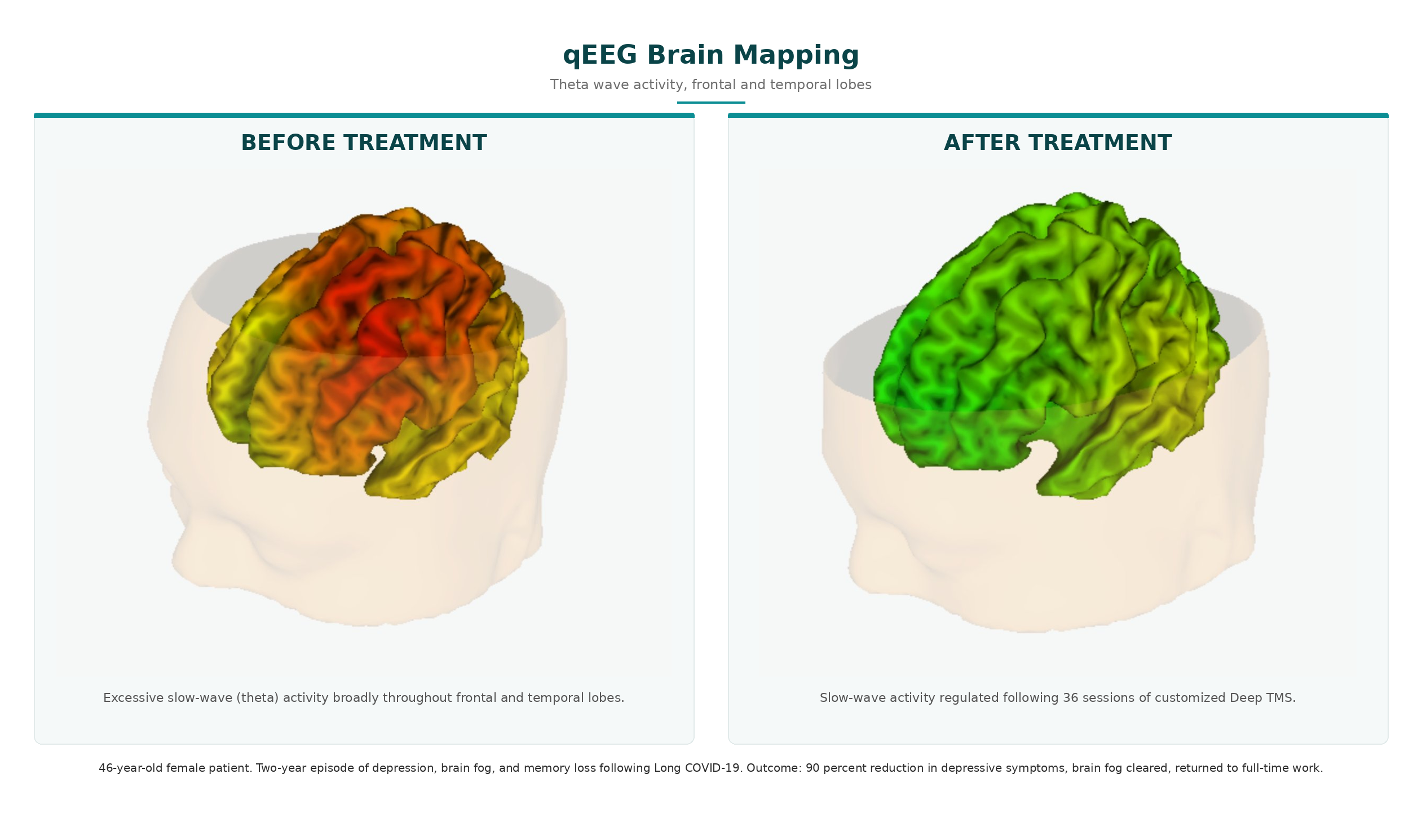
A 46-year-old female patient completed a brain activity mapping after a two-year episode of depression, brain fog, and memory loss following Long COVID-19. The qEEG revealed excessive slow-wave (theta) activity broadly throughout the frontal and temporal lobes.
This case illustrates how qEEG-guided Deep TMS can address neurological symptoms that persist after viral infection. The patient was able to return to work full-time.
Case Study 02
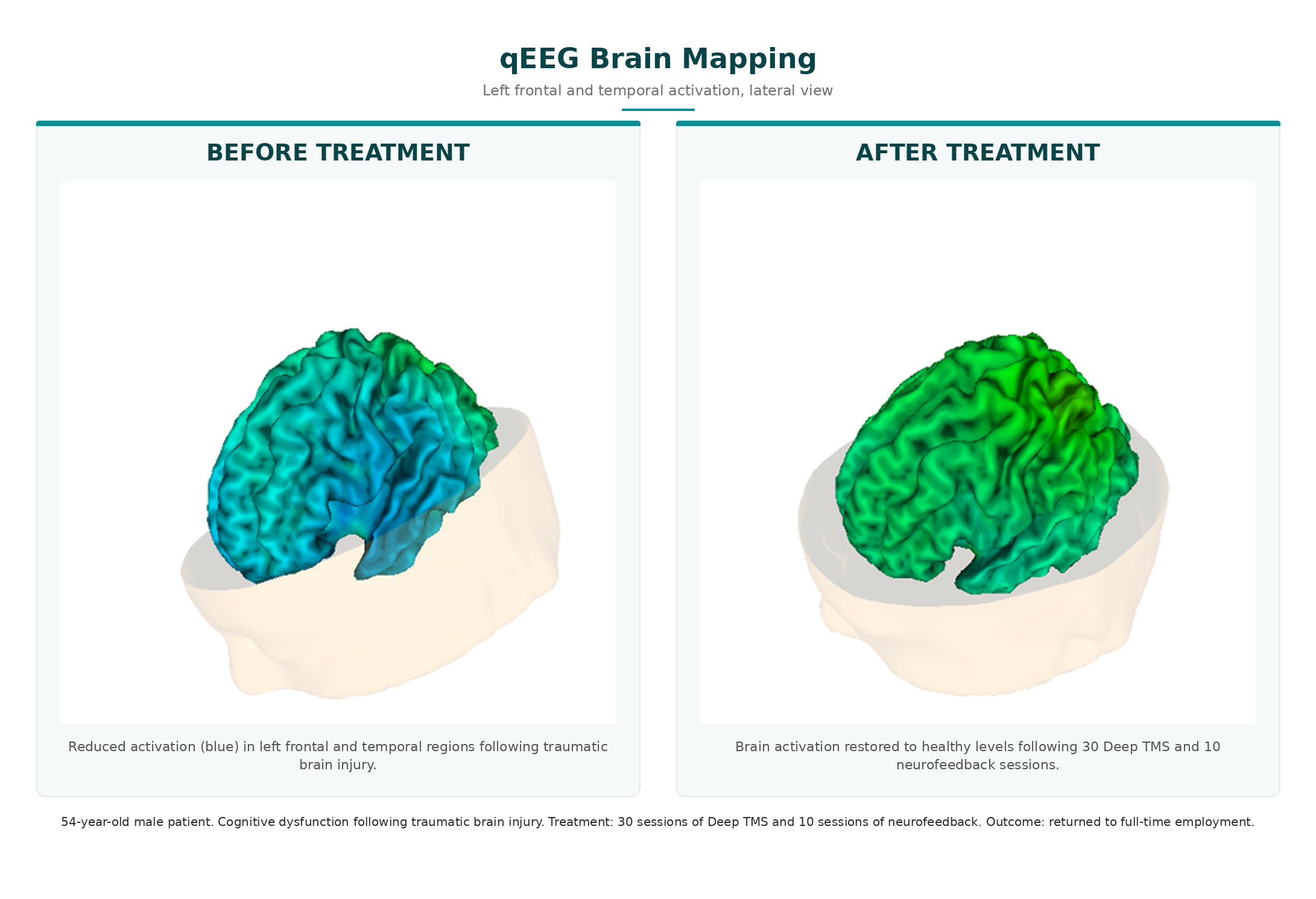
A 54-year-old male patient experienced cognitive dysfunction following a traumatic brain injury. qEEG mapping showed reduced activation in the left frontal and temporal regions consistent with the injury.
This case shows how a combined Deep TMS and neurofeedback protocol can address cognitive symptoms from brain injury. The patient returned to full-time employment following treatment.
Case Study 03
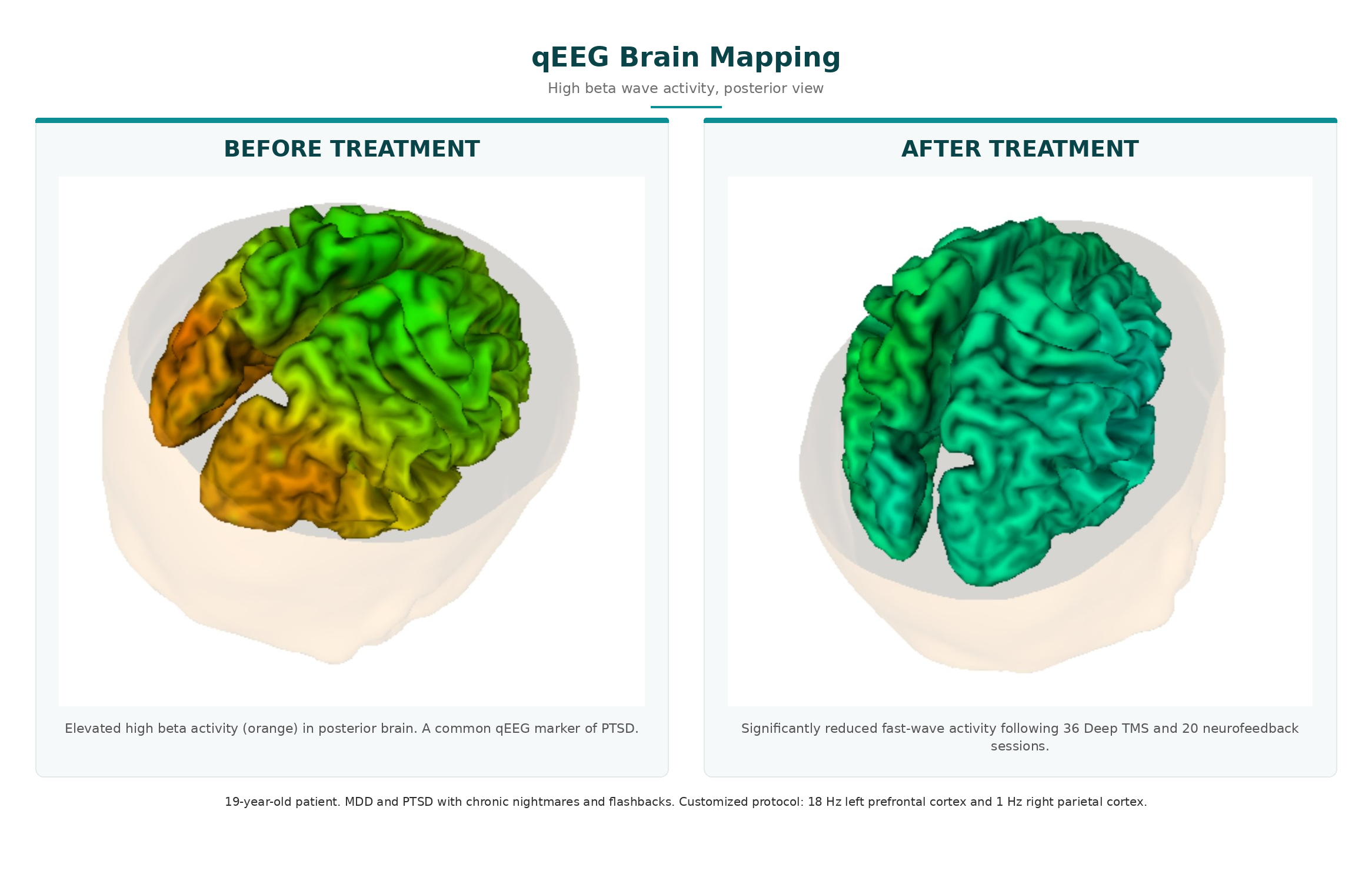
A 19-year-old patient was coping with major depressive disorder and PTSD along with chronic nightmares and flashbacks. qEEG mapping revealed elevated high beta activity in the posterior brain, a common marker of PTSD.
Following 36 sessions of Deep TMS and 20 sessions of neurofeedback, the patient achieved remission of both conditions, reported no nightmares, and showed significantly reduced fast-wave activity in the posterior brain.
Case Study 04
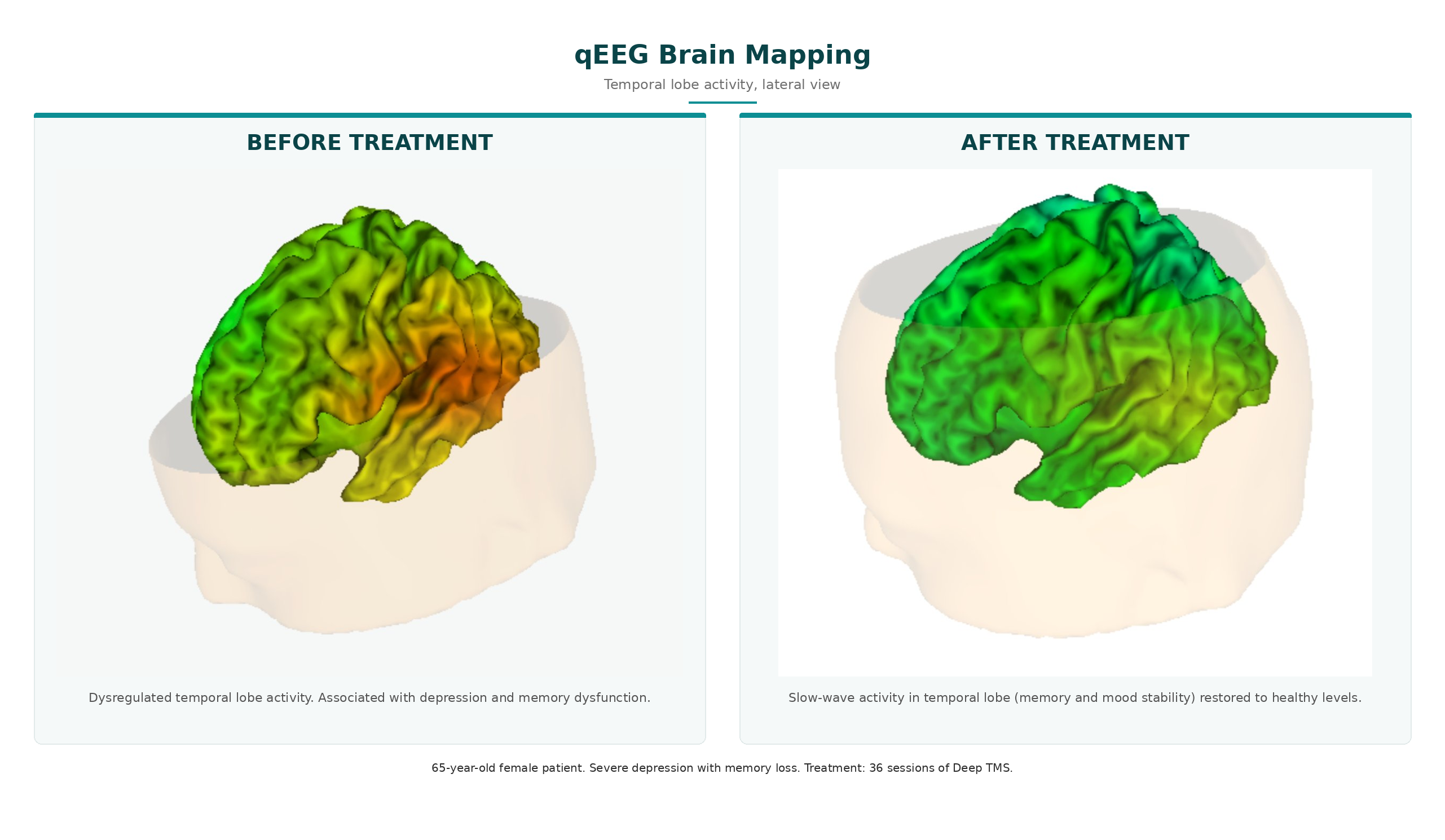
A 65-year-old female patient presented with severe depression and memory loss. qEEG mapping showed dysregulated activity in the temporal lobe, the brain region responsible for memory and mood stability.
This case demonstrates how Deep TMS can address co-occurring depression and cognitive symptoms in older adults through targeted neuromodulation.
Find out during a free, no-obligation consultation with our team.
How It Compares
Every treatment has trade-offs. Here's an honest side-by-side of TMS versus other common options for treatment-resistant depression.
TMS may not be appropriate for patients with seizure disorders. Speak with our team to confirm eligibility.
Patient Stories
Real reviews from real people who have completed TMS therapy at Delray Brain Science.
Results vary. Individual experiences shared here are not necessarily representative of all patients. Reviews are unedited from public sources and reflect each patient's personal perspective.
Book a free, no-obligation consultation with our team.
FAQ
Quick answers to what we hear most often from new patients.
No. TMS is completely non-invasive with no surgical elements. It uses magnetic stimulation similar to an MRI or EEG. You may feel a tapping sensation on the scalp during pulses, but no pain.
A standard course is 36 sessions. A common protocol is 5 sessions per week for the first 4 weeks, then twice a week for 8 weeks. Each Deep TMS session takes roughly 20 minutes.
Every patient is different. Some patients notice changes within the first few weeks, while others require the full treatment course. Antidepressant medications, by comparison, often take 4 to 6 weeks to show effect.
Yes. TMS is FDA-approved and used worldwide. Side effects are typically mild, with headaches and scalp discomfort being most common. The only serious risk is seizures, and that risk is extremely low, lower than many commonly prescribed medications.
In most cases, no. Patients typically continue their prescribed medications throughout TMS therapy. Your physician will review your full medication list and advise you on anything that needs adjustment.
Conventional TMS uses a Figure-8 coil that reaches 0.7cm beneath the skull and takes about 40 minutes per session. Deep TMS uses a Brainsway H-1 coil that reaches 1.7cm beneath the skull, covers a broader area, and completes a session in roughly 20 minutes.
No. TMS is fully outpatient. There's no anesthesia, no recovery time, and no hospitalization required. Patients drive themselves to and from appointments and return to normal activities the same day.
Treatment-resistant depression typically means you've tried antidepressants without significant relief, experienced negative side effects from multiple medications, or your symptoms continue to disrupt daily life despite treatment. A consultation with our team can help confirm whether TMS is a fit.
If antidepressants haven't worked for you, TMS may be worth exploring. Speak with our team to find out if you're a candidate.
